
The success of a social movement hinges less on viral outrage and more on the deliberate shaping of group psychology.
- Crowds are not irrational; they operate on “emergent norms” that leaders can influence.
- Long-term impact is achieved through sustainable infrastructure, not just spontaneous mobilization.
Recommendation: Shift your focus from simply mobilizing participants to strategically architecting the conditions for constructive, predictable, and sustainable collective action.
For any activist or organizer, the sight of a mass gathering is a moment of profound potential. Yet, it is also a moment of immense volatility. The common wisdom tells us to harness passion, spread a clear message, and use social media to amplify our voice. But this approach often mistakes the symptom—a large crowd—for the cause of social change. It treats the group as a monolithic entity to be activated, rather than a complex system of individual psychologies merging into something new and unpredictable.
The reality is that the energy that fuels a movement can just as easily lead to fractured goals and rapid burnout as it can to meaningful policy change. The critical difference lies not in the passion of the participants, but in the strategic foresight of its leaders. What if the key to success wasn’t just about getting people to show up, but about understanding the fundamental psychological shift that occurs when an individual joins a crowd? This is where the work of a leader evolves from a mobilizer to that of a social architect.
This guide moves beyond the platitudes of activism to provide a tactical framework grounded in crowd psychology. We will dissect why groups behave differently than individuals, how to anticipate their reactions, and what critical errors turn peaceful intentions into chaos. By understanding these underlying forces, you can learn to not only gather a crowd but to channel its collective energy toward strategic, sustainable, and ultimately victorious outcomes.
This article provides a comprehensive roadmap for movement leaders. The following summary outlines the key strategic pillars we will explore, from understanding foundational group dynamics to building a movement capable of achieving lasting social justice.
Summary: A Strategic Guide to Movement Leadership
- Why Crowds Act Differently Than Individuals in the Same Situation?
- How to Predict Group Reactions Before Launching a Social Initiative?
- Spontaneous vs. Organized Movements: Which Achieves Policy Change Faster?
- The Organizer’s Mistake That Turns Peaceful Protests Into Chaos
- How to Channel Collective Energy Toward Constructive Outcomes Instead of Dispersion
- The Error That Makes 70% of Social Campaigns Fail Within 6 Months
- When to Initiate Collective Action: The 3 Conditions That Ensure Broad Participation
- Advancing Social Justice Through Strategic and Sustainable Action
Why Crowds Act Differently Than Individuals in the Same Situation?
The fundamental error in leading a group is assuming it is merely a collection of individuals. When people merge into a crowd, a psychological transformation occurs. Individual identity recedes, and a collective consciousness begins to form. This isn’t about losing rationality; it’s about shifting it. As a synthesis of studies on the psychology of crowd behavior highlights, group actions are not random but follow a new, internally consistent logic.
Crowd behavior is not purely random and irrational. When people join a crowd, their behavior often changes compared to how they would behave alone.
– Research synthesis from multiple crowd psychology studies, The Psychology of Crowd Behavior
This phenomenon is explained by the theory of emergent norms. Instead of becoming “mindless,” a crowd rapidly develops and enforces a new, temporary set of social rules. An ambiguous situation, like the start of a protest, creates a vacuum where a few conspicuous actions can define what is considered acceptable for the entire group. This is the difference between a crowd and a mob; a mob is simply a crowd where the emergent norms have shifted to endorse destructive or violent behavior. The leader’s primary task is to proactively establish the *right* emergent norms before the crowd does it for them.
For example, the Los Angeles riots of 1992 were not an act of indiscriminate chaos. Analysis showed that Korean-owned businesses were specifically targeted, demonstrating that the crowd was operating on a shared, purposive understanding. This reveals a critical insight for leaders: a crowd’s actions have meaning. Your job is to define that meaning from the outset, transforming potential chaos into focused, collective action.
How to Predict Group Reactions Before Launching a Social Initiative?
Effective leadership is proactive, not reactive. Instead of waiting to see how a crowd responds, social architects use modern tools to model potential reactions. In the digital age, this means moving beyond simple polling to sophisticated digital sentiment analysis. Every comment, share, and online conversation is a data point revealing the underlying emotional currents and potential trigger points of your target audience. Analyzing these patterns helps you anticipate whether a planned message will inspire solidarity or provoke unintended backlash.
This is not about finding the most popular message, but the most resonant one. For instance, an analysis of climate-related content on YouTube, where some videos reached over 132 million views, shows how certain narrative frames and visual cues generate massive engagement while others fall flat. By studying these digital footprints, you can map the existing landscape of belief and emotion, allowing you to design an initiative that aligns with, rather than fights against, the prevailing sentiment.

This predictive mapping is crucial. It allows you to pre-test messaging, identify potential friction points, and understand the core values of the community you wish to mobilize. Are they motivated more by anger at an injustice, or hope for a better future? Is their primary identity rooted in a local community or a global cause? Answering these questions through data, before you ever call for a rally, is the hallmark of strategic mobilization and the key to avoiding catastrophic miscalculations.
Spontaneous vs. Organized Movements: Which Achieves Policy Change Faster?
Movements often emerge in one of two forms: the spontaneous, viral uprising or the deliberately structured, long-term campaign. Each has a distinct profile of risks and rewards, and choosing the right model depends entirely on your ultimate goal. Spontaneous movements, often fueled by social media, can generate incredible initial momentum and force rapid, superficial concessions from authorities looking to quell unrest. However, their decentralized nature often becomes a liability.
Case Study: The Arab Spring and Occupy Movements
Analysis of the Arab Spring and Occupy movements showed a common pattern. Social media facilitated self-organized, dynamic, and decentralized protest cycles that captured global attention. However, this same structure struggled with long-term sustainability. Without a centralized body for resource management and strategic planning, many of these movements found it difficult to translate initial energy into lasting institutional change, a challenge that more traditionally organized movements are better equipped to handle.
Organized movements, by contrast, are slower to build but are designed for endurance. They prioritize creating infrastructure, developing leadership pipelines, and engaging in the painstaking work of lobbying and policy negotiation. While they may lack the explosive headlines of a spontaneous protest, their impact is often deeper and more permanent. The following table, based on dynamics observed in numerous modern social movements, breaks down the key differences.
| Aspect | Spontaneous Movements | Organized Movements |
|---|---|---|
| Formation Speed | Rapid, emotion-driven | Gradual, strategy-driven |
| Predictability | Low, unpredictable tactics | High, established patterns |
| Resource Mobilization | Viral, decentralized | Structured, centralized |
| Sustainability | Often short-lived bursts | Long-term infrastructure |
| Policy Impact | Quick concessions possible | Deeper structural change |
The strategic imperative is not to declare one model superior, but to understand which tool is right for the job. Do you need to block a specific piece of legislation tomorrow? A spontaneous mobilization might be effective. Do you need to dismantle a systemic injustice over the next decade? An organized, sustainable structure is non-negotiable.
The Organizer’s Mistake That Turns Peaceful Protests Into Chaos
The line between a powerful, peaceful protest and a chaotic riot is perilously thin. The critical mistake many organizers make is focusing entirely on the message and the turnout, while neglecting the psychological architecture of the event itself. As Britannica’s analysis of collective behavior notes, a state of social unrest is uniquely volatile because its energy has not yet been given a clear direction. An organizer’s failure to provide that direction is an invitation for chaos to fill the void.
This failure manifests in several concrete ways. The single greatest error is the absence of clearly communicated behavioral norms *before* the event begins. Participants must know what is expected of them: is this a silent vigil, a loud but stationary rally, or a moving march? Without this guidance, the actions of the most extreme participants—or even agent provocateurs—can quickly become the emergent norm for the entire crowd.
Preventing this descent into chaos requires meticulous preparation that goes far beyond logistics. It is about actively managing the crowd’s internal dynamics. Key preventative measures include:
- Establishing and Over-Communicating Norms: Before and during the event, use all channels to state the code of conduct.
- Training and Deploying Marshals: A visible team trained in de-escalation can identify and neutralize potential flashpoints before they ignite the crowd. Their presence provides a calming visual cue of order.
- Creating Strong Unifying Symbols: Simple, powerful chants, songs, or visual symbols (like a shared color) reinforce group identity and shared purpose, making it harder for divisive actions to take hold.
- Maintaining Clear Communication Channels: Organizers must be able to address the entire crowd instantly to dispel rumors or redirect energy.
Ignoring these elements of crowd management is not just a tactical oversight; it is a fundamental failure of leadership that abdicates control of the movement’s most valuable asset—its people—to the most unpredictable forces.
How to Channel Collective Energy Toward Constructive Outcomes Instead of Dispersion
Mobilizing a crowd is only the first step. The greater challenge is preventing that initial burst of energy from dissipating into social media noise or directionless anger. The key is to design clear, tangible pathways for action that convert passive supporters into active participants. This means every piece of communication should not only inform or inspire but also provide a specific, low-friction “next step.”
Strategic media use is central to this process. It’s not about going viral for the sake of views; it’s about using narrative to create a sense of place and purpose. The Invisible Children’s “Kony 2012” campaign, for all its controversy, was a masterclass in this. Through powerful storytelling and specific calls to action, their YouTube videos created a tangible connection between viewers and the cause. This transformed passive viewership into specific, channeled actions, demonstrating how digital tools can sustain engagement beyond the initial emotional spark.
This is where the concept of a “ladder of engagement” becomes critical. Not everyone is ready to get arrested, but many are willing to sign a petition. Others might share a post, donate a small amount, or attend a local meeting. A smart leader architects a series of escalating actions, allowing individuals to participate at their own comfort level. This creates a sustainable flow of energy, moving people from low-commitment online actions to higher-commitment offline engagement, ensuring the movement builds momentum rather than burning out.
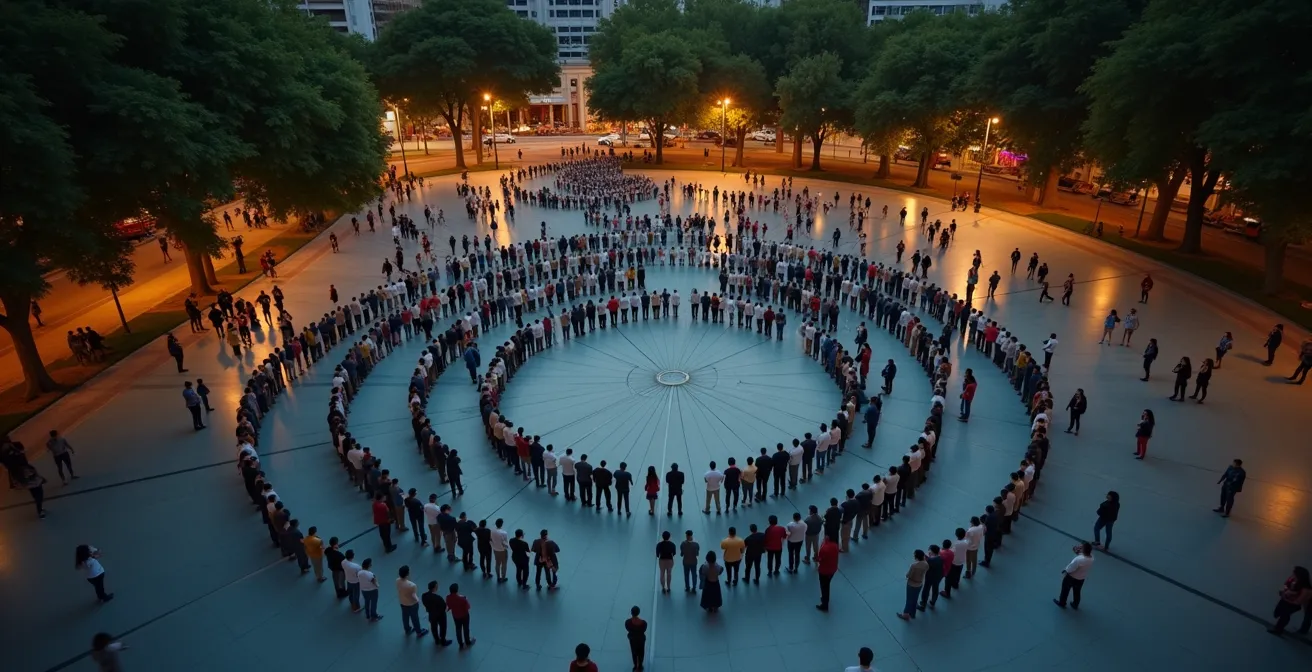
Ultimately, channeling energy means transforming a temporary event into a lasting ritual of participation. Whether through weekly community check-ins, coordinated digital campaigns, or regular, small-scale local actions, the goal is to make engagement a habit, not a one-time outburst. This is how collective energy becomes constructive power.
The Error That Makes 70% of Social Campaigns Fail Within 6 Months
The high failure rate of modern social campaigns isn’t due to a lack of passion, but a fundamental misunderstanding of the tools being used. Many leaders fall into the trap of equating social media visibility with genuine power, a fatal strategic error. They celebrate viral hashtags and high follower counts, unaware that the very platforms they rely on may be working against their long-term goals.
Celebratory accounts of the Arab Spring uprisings, and the Occupy and Indignados movements, often focus on affordances while missing how commercial orientation of social media platforms may work against activists’ intended goals.
– Etter, M. and Albu, O.B., Activists in the dark: Social media algorithms and collective action
The core error is confusing mobilization with organization. Social media is an incredible tool for rapid mobilization—getting many people to pay attention to one thing at one time. However, it is a poor tool for deep organization, which requires nuanced discussion, trust-building, and strategic planning. The algorithms of these platforms are designed for fleeting, emotional engagement, not for the sustained, sometimes tedious, work of building a resilient organization.
This leads directly to the “Victory Vacuum.” A movement optimized for social media often achieves a quick, visible concession from authorities. But because it has no underlying organizational structure, it has no plan for what to do next. The coalition, united by a single, now-achieved demand, fractures. Leaders burn out from the pressure of being the sole focal point. Resources, which were poured into the initial mobilization, are non-existent for the long-term legal and administrative work that follows. The movement that looked so powerful a month ago simply vanishes.
When to Initiate Collective Action: The 3 Conditions That Ensure Broad Participation
Timing is everything. Launching a call to action prematurely can lead to a demoralizingly low turnout, crippling a movement before it even begins. Conversely, waiting too long can mean missing a critical window of opportunity. Sociological research has moved beyond guesswork to identify the precise conditions under which people are most likely to convert their beliefs into action. The decision to mobilize should be a calculated one, triggered only when these key factors are aligned.
An extensive meta-analysis of 494 different studies on collective action has confirmed that broad participation is not random. It is the result of three specific perceptions converging within a target population. A leader’s job is to monitor and cultivate these perceptions, waiting for them to reach a critical threshold before initiating a large-scale action. The absence of even one of these conditions dramatically increases the risk of failure.
The three essential preconditions are Threat Perception, Group Efficacy, and Social Proof. Each has distinct indicators that a savvy organizer can track to gauge the ripeness of the moment for mobilization. This framework allows you to move from hoping for a good turnout to engineering one.
| Condition | Description | Indicators |
|---|---|---|
| Threat Perception | The issue is seen as severe, urgent, and personal to a large number of people. | Rising media coverage, an increase in personal testimonies, a clear ‘villain’ or event. |
| Group Efficacy | People believe that the group, acting together, has a realistic chance of success. | Recent victories by similar movements, a growing and diverse coalition, visible resources. |
| Social Proof | There is visible evidence that others are already committed to acting. | Trending hashtags, a high number of pledge signatures, small but visible preceding protests. |
The strategic takeaway is clear: do not issue your primary call to action until you can confidently say that all three of these conditions are met. Your preceding work should be focused on cultivating them—highlighting the personal threat, celebrating small wins to build efficacy, and creating low-risk opportunities for people to show their support and build social proof.
Key Takeaways
- Collective behavior is not random; it is governed by emergent norms that can be strategically shaped by leadership.
- Sustainable movements prioritize building organizational infrastructure over achieving fleeting viral moments on social media.
- Successful mobilization depends on three key psychological triggers: perceived threat, belief in group efficacy, and visible social proof.
Advancing Social Justice Through Strategic and Sustainable Action
Achieving true social justice is a marathon, not a sprint. The final and most crucial evolution for a movement leader is to shift from organizing events to building a resilient, self-sustaining movement ecosystem. This means recognizing that a movement is not a single entity with one charismatic leader, but a diverse network of actors, each playing a critical role. As analysis of the #BLM and #StopAAPIHate movements has shown, this ecosystem includes public figures, independent vloggers, news reporters, legal aid groups, and local organizers, all contributing in different ways.
The leader’s role in this model is not to command, but to connect and support. It is to ensure that resources flow to where they are needed, that different groups within the coalition are communicating, and that the movement has the infrastructure to outlast any single campaign or individual. This focus on sustainability is what separates movements that create headlines from those that create history. It requires a conscious effort to build institutional memory, develop diverse leadership pipelines, and establish metrics for success that go beyond immediate policy changes to include things like narrative shifts and increased community resilience.
Building this infrastructure is the ultimate act of channeling collective energy. It creates a permanent asset for social justice, one that can adapt to new challenges and mobilize effectively time and time again. It is the transition from a protest to a political force.
Action Plan: Building Sustainable Movement Infrastructure
- Diversify Leadership: Actively recruit and train a pipeline of new leaders to move beyond reliance on charismatic founders and prevent single points of failure.
- Define Roles: Create distinct, valued roles for different personality types and skill sets (e.g., researchers, communicators, event organizers, community caregivers) to maximize participation.
- Expand Success Metrics: Establish clear metrics beyond policy wins, such as shifts in public narrative, increased community resilience, and the number of new leaders trained.
- Build Coalitions: Forge formal partnerships with other movements to share resources, knowledge, and political capital, strengthening the entire ecosystem.
- Conduct Ethical Audits: Implement a regular process to evaluate the ethical boundaries of your mobilization tactics to maintain legitimacy and long-term public trust.
By applying these principles of social architecture, you move beyond simply gathering a crowd. You begin the essential work of building a disciplined, strategic, and resilient force capable of achieving and sustaining meaningful social justice.
Frequently Asked Questions on Leading Social Movements
Why do movements lose momentum after initial success?
This is often due to the “Victory Vacuum.” When a movement achieves its primary, highly visible goal, it can lose its unifying purpose. Without a pre-planned “what’s next” strategy, the coalition of groups that came together for that single issue may fracture, and participant energy dissipates.
What role does leadership structure play in movement failure?
Over-centralizing responsibility onto a few charismatic leaders creates critical single points of failure. When these leaders burn out, are targeted by opposition, or leave the movement, the entire structure can collapse due to a lack of delegated authority and a shallow leadership pipeline.
How does resource allocation affect longevity?
A common mistake is allocating the vast majority of resources (time, money, volunteers) to the initial, high-visibility mobilization phase. This starves the long-term infrastructure—such as legal support, administrative staff, and ongoing research—that is essential for sustainability and for converting protest energy into lasting policy change.